
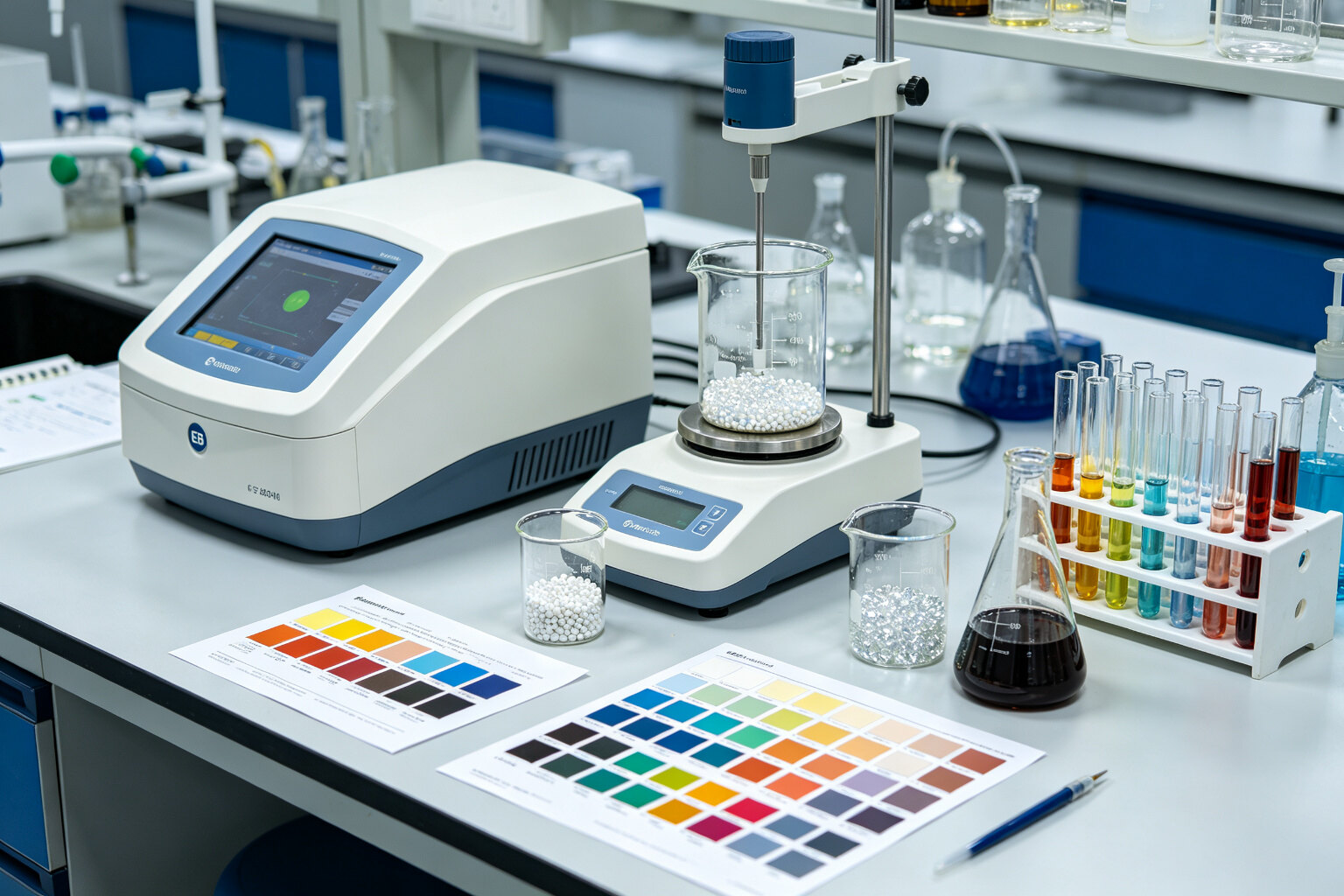
<p>1. Introduction</p><p></p><p>Electron Beam (EB) curing has become the leading high-energy radiation process in modern coatings, delivering unmatched benefits for deep-through curing, zero photoinitiator residue, ambient-temperature operation, and exceptional production efficiency. As EB adoption accelerates across wood coatings, food packaging, optical fibers, composites, and metal packaging, selecting and controlling EB-curable colorants is critical to final coating performance, production stability, and product compliance. DENSON (Dongguan DENS Functional Materials Co., Ltd.), a specialist pigment manufacturer, has established a comprehensive quality control system for its EB-curable colorant series—spanning raw material selection, process control, finished-product testing, and application validation. This guide outlines key selection parameters and quality control protocols for DENSON EB colorants, illustrated with three application cases that show how proper parameter selection and rigorous QC ensure reliable performance across different EB environments. The guidelines help coating formulators, production engineers, and quality managers make informed decisions when selecting and using EB-curable colorants.</p><p></p><p>2. Technical Features and Mechanism</p><p></p><p>EB-curable colorants differ fundamentally from conventional solvent-based or water-based systems in their dispersion chemistry and performance requirements. The core challenge is maintaining pigment stability and curing compatibility under high-energy electron beam radiation (typically 150-300 kV acceleration voltage, 20-100 kGy dose). DENSON EB colorants are built on three foundational technologies: radiation-resistant pigments, acrylate-functionalized dispersant systems, and precise rheology control.</p><p></p><p>DENSON's quality control system spans multiple stages. Incoming pigments undergo batch-to-batch color difference testing (ΔE ≤1.0), electron beam irradiation aging tests (50-100 kGy, ΔE ≤2.0), and heavy metal analysis (compliant with EU RoHS and REACH). During production, dispersion is monitored via fineness gauge (≤5 μm), particle size distribution (D50, D90, span), and viscosity tracking (Brookfield viscometer, 25°C). Finished products are tested for color strength (±5% tolerance), viscosity (±10% tolerance), fineness, storage stability (50°C heat storage, 30 days), and curing compatibility with standard EB resin systems. This multi-stage QC ensures every batch meets consistent performance specifications.</p><p></p><p>3. Application Case Study 1: EB Curing Wood Coating Quality Control</p><p></p><p>A major wood flooring manufacturer running an EB roller-coating line needed consistent color matching across batches for dark walnut and deep brown flooring. The main challenge was maintaining batch-to-batch color consistency while ensuring complete deep-through curing in dark color systems. DENSON EB colorants were used at 4%-8% loading in an epoxy/polyurethane acrylate hybrid system, with line speed 20-30 m/min, EB dose 30-50 kGy, and 200 kV acceleration voltage.</p><p></p><p>The QC protocol included: incoming batch verification using a spectrophotometer (CIE L*a*b* space, ΔE ≤1.0 vs. standard); inline color monitoring at 30-minute-unit intervals; and curing degree verification via solvent extraction (gel content ≥95%) and MEK double rub (≥100 double rubs). DENSON provided a color standard card and batch color difference report with each delivery, enabling a closed-loop color control system.</p><p></p><p>Results showed that with proper selection and QC, batch-to-batch color difference stayed at ΔE ≤0.8, curing was consistent across all dark systems, and scrap due to color mismatch dropped from 3.5% to below 0.8%. Key selection parameters were pigment radiation resistance (≥100 kGy), dispersant acrylate functionality (2-3), and colorant viscosity (3000-6000 mPa·s for roller coating).</p><p></p><p>4. Application Case Study 2: EB Curing Food Packaging Safety Verification</p><p></p><p>A food packaging printer required EB-curable inks for premium boxes meeting strict FDA 21 CFR 178.3297 and EU 10/2011 food-contact regulations. The focus was ensuring no hazardous migration while maintaining print quality and full cure. DENSON EB colorants were used at 8%-15% loading in four-color offset and spot inks, with production rates of 15,000-20,000 sheets/hour, EB dose 20-40 kGy, and 200 kV acceleration voltage.</p><p></p><p>The QC protocol covered: raw material certification (FDA declarations, REACH SVHC screening, heavy metals per EN 71-3); finished-product migration testing (total migration in 4% acetic acid at 40°C for 10 days, limit ≤10 mg/dm²; specific migration of primary aromatic amines, limit ≤0.01 mg/kg); sensory evaluation (odor/taste per ISO 17529); and curing verification (gel content ≥95%, extractable photoinitiators below detection limit).</p><p></p><p>DENSON supplied a full food-contact compliance package including regulatory declarations, third-party test reports, and batch-specific COAs. Results showed total migration consistently ≤0.5 mg/dm² (well below limits), no detectable primary aromatic amines, and no odor or taste transfer. Critical selection parameters were pigment purity (food-contact grade), dispersant migration resistance (acrylate-functionalized, non-extractable), and residual monomer content (≤0.1%).</p><p></p><p>5. Application Case Study 3: EB Curing Optical Fiber Coating Production Control</p><p></p><p>An optical fiber manufacturer needed EB-curable colorants for identification coatings on ribbon fibers, demanding extreme uniformity, fast cure, and mechanical reliability. Parameters included die coating at 1000-2000 m/min, coating thickness 25-60 μm, and millisecond-level EB curing. DENSON EB colorants were used at 2%-6% loading for standard fiber colors (blue, orange, green, brown, gray, etc.).</p><p></p><p>The QC protocol included: pigment particle size control (D50 ≤200 nm, D90 ≤500 nm, span ≤2.0) to prevent die clogging and defects; precision viscosity control (±5% tolerance) for consistent thickness; storage stability checks (50°C heat storage, 30 days, viscosity change ≤5%, no sedimentation); and cured-coating mechanical tests (tensile strength ≥30 MPa for outer coating, elongation at break ≥100% for inner coating, temperature cycling from -40°C to +85°C for 100 cycles without cracking).</p><p></p><p>DENSON dedicated a production line for optical fiber-grade colorants with enhanced filtration (1 μm absolute) and particle size monitoring. Results showed coating thickness deviation ≤±2 μm, no die clogging over 72 continuous hours, and cured coatings passing all mechanical and environmental reliability tests. Essential selection parameters were nano-scale pigment size (D50 ≤200 nm), ultra-low viscosity variation (±5%), and exceptional storage stability (no sedimentation after 6 months at -18°C).</p><p></p><p>6. Key Selection Parameters and Usage Recommendations</p><p></p><p>Based on these cases and DENSON's experience, we recommend the following key parameters for EB-curable colorants:</p><p></p><p>First, pigment radiation resistance: require suppliers to provide EB irradiation aging data at the actual application dose (typically 20-100 kGy), with post-irradiation ΔE ≤2.0. For dark colors and high-dose applications, prioritize inorganic pigments and surface-treated high-performance organic pigments.</p><p></p><p>Second, dispersion system reactivity: choose colorants with acrylate-functionalized dispersants (average functionality 2-3) that participate in EB curing polymerization to prevent post-cure pigment migration. Avoid non-reactive dispersants for permanent coatings.</p><p></p><p>Third, pigment particle size and distribution: for thin coatings (≤50 μm) and high-precision die coating, require D50 ≤300 nm and span ≤2.0. For conventional roller and spray coating, D50 ≤5 μm is generally acceptable.</p><p></p><p>Fourth, viscosity and rheology: match colorant viscosity to the application method—roller (2000-8000 mPa·s), spray (500-2000 mPa·s), die coating (100-1000 mPa·s), offset printing (5000-15000 mPa·s). Request rheology curves for non-Newtonian systems.</p><p></p><p>Fifth, purity and safety: for food packaging, medical devices, and children's products, require compliance with FDA, EU 10/2011, GB 4806, or equivalent standards, with full documentation and third-party test reports.</p><p></p><p>Sixth, curing compatibility: run curing tests under actual EB equipment settings (voltage, current, dose, line speed) to confirm that adding the colorant does not reduce cure below 90% or degrade mechanical properties.</p><p></p><p>Usage recommendations: establish incoming inspection for every batch (color difference, viscosity, fineness, curing compatibility); maintain traceable color standard libraries; calibrate EB equipment regularly (monthly or after 500 hours of operation); store colorants at 5-35°C away from direct sunlight with FIFO inventory management; and perform periodic storage stability checks to ensure specs are maintained throughout shelf life.</p><p></p><p>7. Conclusion</p><p></p><p>Selecting and controlling EB-curable colorants is critical to coating performance, production stability, and regulatory compliance. DENSON EB colorants, backed by a comprehensive multi-stage QC system—from raw materials through production, testing, and application validation—deliver consistent, reliable performance across diverse applications. Through three detailed cases—wood coating color consistency, food packaging safety, and optical fiber coating precision—we demonstrated that systematic parameter selection and rigorous QC ensure robust EB curing performance. As EB technology expands into new areas, manufacturers and end-users should prioritize suppliers with established QC systems, full testing capabilities, and application-specific support. By focusing on the six key parameters—pigment radiation resistance, dispersion reactivity, particle size, viscosity, purity compliance, and curing compatibility—and implementing structured QC protocols, manufacturers can maximize EB curing benefits while ensuring product quality and regulatory compliance.</p>